
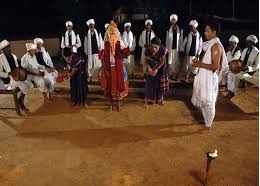
Ranmale is a ritualistic and folk theatre form based on mythological stories from the popular Indian epics of Ramayan and Mahabharat. It is presented during the Holi festival which is celebrated as Shigmo (spring festival) in Goa and Konkan areas. The word ‘Ranmale’ has evolved from two words, ‘Ran’ which means battle and ‘Male’ representing the traditional torch used as a source of light during the performance.
It is believed that its origin is rooted in ancient times when a group of visiting artists peeved by the demands of the local settlers killed them while they were engrossed in watching their performance, since then Ranmale is performed as an act of atonement of that past event. This form comprises dance, drama and folk songs called Jats.
Each participant of the drama makes his entry to the tune of folk songs. The traditional instrument, Ghumat is an earthenware drum with one of its ends covered with the skin of the monitor lizard and the other mouth kept open. The accompanying instruments Kansale, cymbals of brass, are used for the base rhythm. Jats are sung by the initiator of the folk drama called Sutradhar, while the folk artists stand in a row on the stage acting like a backdrop. In the village of Zarme, the presentation of Ranmale is a must after the annual festival of Chorotsav, while in Caranzole it precedes the festivities. It is a popular belief that nonperformance of the element may invite the wrath of the village deity.
Category: Blog
Intangible Cultural Heritage of India
hornbill festival
According to Wikipedia, intangible cultural heritage is a practice, representation, expression, knowledge, or skill considered by UNESCO to be part of a place’s cultural heritage; it comprises “nonphysical intellectual property, such as folklore, customs, beliefs, traditions, knowledge, and language” in contrast to tangible heritage.
hornbill festival
In other words it is not at all about anything physical, like a monument, a fort or a palace. Intangible cultural heritage refers to events and activities like festivals, rituals and things that delve deeper into the traditions and social structure. For those who like their holidays full of rich and immersive moments, these special events open up a world of enchanting sights and experiences.
The National List of Intangible Cultural Heritage (ICH) of India is an attempt to recognize the diversity of Indian culture embedded in its intangible heritage. It aims to raise awareness about the various intangible cultural heritage elements from different states of India at national and international level and ensure their protection.
Following UNESCO’s 2003 Convention for the Safeguarding of the Intangible Cultural Heritage, this list has been classified into five broad domains in which intangible cultural heritage is manifested:
Oral traditions and expressions, including language as a vehicle of the intangible cultural heritage
Performing arts
Social practices, rituals and festive events
Knowledge and practices concerning nature and the universe
Traditional craftsmanship
Given below is the List of Intangible Cultural Heritage of India:
Andhra Pradesh
Kalamkari
KalamkariSri Kalahasti near the temple town of Tirupati in Andhra Pradesh specializes in producing temple cloths – Kalamkari (lit. pen-work) – primarily used for their temple festivals or as wall hangings. The stories from the epics Ramayan , Mahabharat and the Puranas are painted as continuous narratives, each important event framed in a rectangle. Sometimes short episodes from the stories are also painted.
The relevant Telugu verses explaining the theme are also carried below the artwork. Considerable degree of imaginative and technical skill is required to condense the stories into illustrative formats. The master craftsman draws the outline of the design with Kalam or pen on the myrobalan treated cloth using charcoal sticks made from tamarind wood. He draws from the rich repertoire of design and motifs and iconographical details of various god and goddesses as laid down traditionally.
The colors are obtained from vegetable and mineral sources. The main colors used are black, red, blue and yellow and alum is used as mordant to fix the colors and to obtain the reds. The gods are painted blue, the demons and evil characters in red and green. Yellow is used for female figures and ornaments. Red is mostly used as a background. The cotton cloth is washed in flowing water to remove starch and between dyeing and bleaching. Keeping up with the times, the Kalamkari artists are now designing also for their modern clientele.
Oggukatha: Traditional Folk Theatre
Oggukatha Traditional Folk TheatreOggukatha is a traditional folk theatre form which is an ancient narrative form of Telugu speaking regions. It derives its name from ‘Oggu’ – a small hand drum associated with Lord Shiva and literally means, ’oggu tales’. It is performed by the pastoral communities like Kuruma and Golla(Yadav’s), of the Deccan plateau.
These tradition-loving and ritual-performing troops move from place to place, narrating the stories of their caste gods. Oggu Poojaris are the traditional priests of the Yadav’s and perform the marriage of Mallanna with Bhramaramba. Oggukatha is performed in different contexts ranging from Hindu mythologies to general issues of the society. More than 100 Oggukatha groups exists today, each comprising of 4 to 6 performers.
Late Middey Ramulu and Chukka Sattaiah were the most famous artists who made the form very popular. The performance and its training comprises of ten types of singing styles, dance movements, makeup, costumes, unique use of musical orchestration with instruments etc. Improvisation and imagination are the other major key elements in this form. This makes the learning process more tedious and time consuming.
As time is changing this age-old tradition is undergoing many changes and there is a need to develop proper attention towards teaching and training methods of this form, in order to transfer it to the next generation. Documentation of preparations and performances of the tradition needs to be done along with a critical analysis of the existing informal mode of teaching and training.
Tolu Bommalatta -Shadow Puppet Theatre Traditions of India
Tolu Bommalatta -Shadow Puppet TheatreThere are six shadow puppet theatre traditions across different regions in India, which are locally known as: Chamadyacha Bahulya in Maharashtra, Tolu Bommalatta in Andhra Pradesh, Togalu Gombeyatta in Karnataka, Tolu Bommalattam in Tamil Nadu, Tolpava Kuthu in Kerala and Ravanchhaya in Orissa.
Though these forms have distinct regional identities, languages and dialects in which they are performed, they share a common worldview, aesthetics and themes. The narratives are mainly based on the epics of Ramayana and Mahabharata, Puranas, local myths and tales. They communicate significant messages to the rural community besides entertainment. The performance begins with an invocation on a ritually set up stage in a village square or a temple courtyard. Stock characters provide comic relief.
A sense of rhythm and dance is inherent in all the traditions, across regions. The puppets are crafted from either goat or deer skin. They are manipulated from behind the screen, where lighting is provided to cast shadows. Puppet performances are a part of festivals, celebrations of special occasions and rituals, and sometimes staged to ward off evil spirits and to invoke the rain gods in times of drought in rural areas.
Arunachal Pradesh
Traditions associated with funerals of Idu Mishimi Tribe
Idu Mishimi TribeIdu Mishmis are one of the significant indigenous tribes of Arunachal Pradesh domiciled in the districts of Dibang Valley, Lower Dibang Valley, Lohit and few pockets in the vicinity of East Siang and Upper Siang.
The funeral traditions of Idu Mishimis are very unique in nature. Generally the funeral rituals are performed 3 to 5 days and it depends upon the nature of death. The Idu Mishimis believe that there is a continuation of life after death. It is believed that after death life is transformed from the materialistic world to the divine world i.e., the land of soul which is locally known as muduasialoko. Igu, the shaman, plays an important role in funeral rituals.
He performs a number of rituals, dance and music, and offerings in the house of the dead continuously for days and nights together without sleeping and the people who are mourning in the house should not leave the house without the permission of the Igu. After the ritual performances in the house of the dead, the Igu performs several rituals in broacha, the graveyard, and accompanying the soul from the house of the dead (aatiyakong) to the land of the souls (asialoklo).
Songs of Shaman
The shamans have important function in clan-life of different tribes of Arunachal Pradesh. In Arunachal Pradesh among different tribes, Shaman is mostly seen as a diviner, communicator, negotiator, healer, ritual specialist, and religious expert but neither as a magician nor a mystic. S/he is the middleman between human and spirits who can communicate with the spirits on their behalf.
As Tani people believe in the existence of spirits, they need human specialists, a shaman, who have experience and can get access to the spirit world as a communicator. Each clan has important religious specialists who initiate and foster contact with the spirits and divinities. They will contact the spirits and convey the messages between human and spirits. They have the power to call the spirits for blessings, support and protection against evil. They also have the power to enter into the spirit world and to communicate and negotiate with them that cause people to become sick.
They enter into a dialogue with the spirits and ask for prosperity and health of the members of the clan. Shamans are also the store house of traditional knowledge in the form of legends, myths, ritual incantations etc. They are well versed in ritual performances and knowledge and wisdom associated with it.
Sowa-Rigpa (Knowledge of Healing or Science of Healing)
Sowa-RigpaThe term Sowa Rigpa is derived from Bhoti language which means ‘Knowledge of Healing’. It is an ancient Indian medical system concieved and propounded by Lord Buddha in India and later was enriched in the entire Trans- Himalayan region. Sowa Rigpa has been developed and incorporated into different environmental and cultural contexts through the centuries.
(Sowa-Rigpa has moulded itself into the socio-cultural lineage since ages), where every village has had an Amchi family to look after public health. Today, Sowa Rigpa is acknowledged as a traditional medical system by the governments of India, Bhutan, Mongolia and Tibet. The principle medical text “rGyud-bZi” (Chatush Tantra-a texbook of fundmental principles of Sowa-Rigpa in Sanskrit language) was pioneered by Lord Buddha and translated into Bhoti language around 8th -12th Century and amended by Yuthok Yontan Gombo and other scholars of Trans Himalayan region according to the socio-climatic conditions.
The fundamental principles of Sowa Rigpa is based on Jung-wa-nga (Panchmahabutha), Nespa-sum (Tridosha), Luszung-dun(Saptadhatu) etc. According to Sowa- Rigpa health is an equation of balance of tridosha (English translation) and five cosmophysical energies (Panchmahabuta), balance within the body, balance with the enviornment, and with the Universe.
Pulse examination and astrological evaluation/analysis of an individual are the unique diagnostic tools in Sowa-Rigpa. The natural resources which are safe, effective and time tested are used as the sources of medication. Sowa Rigpa education, healthcare delivery and research is formally recognized and promoted by the Government of India.
Lores and Rituals of Nocte
Lores and Rituals of Nocte tribeThe Noctes are one of the major tribes of Arunachal Pradesh. They occupy the North Eastern part of the Tirap district which forms a part of the mountainous tract of the North-eastern frontier of India and upper Myanmar. The Noctes celebrate two major festivals in the villages called Chalo and Ronglo every year. The purpose of celebrating the festival is to propitiate the god, Almighty Rang for his blessing in order to attain good crops and wellbeing of the village. The festival being celebrated in Lazo area of the Olos is known as Worang.
The way of celebration differs from village to village. The Ronglo festival is celebrated during May-June, after reaping the millet. Some villages have now given up millet cultivation and therefore they do not celebrate this festival. The Chalo festival is celebrated during November every year. This celebration has a special significance to the villagers. These festivals signify the end of one cycle and the beginning of another. The new Jhum cultivation is taken up immediately after this festival.
Deere Yameng
Deere Yameng Adi Tribe of ArunachalThe Adi Tribe of Arunachal had a grand traditional socio-cultural institution called ‘DEE:RE’, which used to be the epicentre of day to day village activities like festival, social Taboo, rituals, cultivation and religious ceremony. All activities concerning the village relating to emergency situations, discrimination, knowledge, hunting to agricultural matters and entertainment including festivities are decided and started in the DEE:RE with religious fervour. It is simply considered as a community hall but it has its own origin importance and mythologies attached to it.
It is also considered as the centre for empowering the priest and sages for excellence in the field of music, dance, Drama and oral knowledge. Therefore, this Socio-Cultural institution was also considered as the temple of learning in the past. The village youth (Yameng) who attained the age of adolescence were mandated to attend the temple daily to undergo training in the socio-cultural and religious fields including performing arts normally for a two year duration.
The senior group of the Yameng took the responsibility to contact reputed ‘Gurus’ for teaching in the temple in various fields like singing folk songs – Ponung, Bare Delung, Pange Dirge and on their accompanying dance. Besides, these Yameng were trained to be volunteers of the village and were called upon at short notice during emergency situations. This type of training and teaching with social support used to instill confidence among the yameng’s and adherence to their own faith and culture.
Assam
Sattriya Music, Dance and Theatre
Sattriya AssamSattriya Music, Dance and Theatre is a composite body of multiple forms of artistic expressions combining music, dance, drama and other allied arts bearing great significance and impact on both spiritual and social life of Assam. Based on a vast corpus of devotional compositions in Brajavali as well as in vernacular Assamese and woven with a melodic and rhythmic structure distinctive of its own, this body of cultural expressions is inextricably associated with rituals and ceremonies in the Sattra, a monastic institution of Vaisnavite faith and learning.
Permeated with intense spiritual fervour and educational value, the Sattriya tradition has become an indispensable part of the religious, social and cultural life of the practicing community as a medium of internalizing the experience of the Divinity. Always performed with deep emotional attachment to the accompaniment of drums and cymbals, this is a unique testimony of religious experience integrated with aesthetic elegance.
The style of music and dance combining elements from the pan-Indian and Indo-Mongoloid traditions is distinct from the major schools of North and South Indian music and dance. The theatre also, celebrated as a tradition next only to the Sanskrit drama and theatre, has several distinguishing features of its own. The Sattriya Music, Dance and Theatre incorporating melodic and rhythmic improvisations from time to time, is mostly a group work having a performance text orally handed down to generations.
Khol AssamKhol
Mahapurush Sankardev created the instrument Khol with his own ideas for the purpose of using it in the play ‘Chihnayatra’. The egg-shaped body of the Khol, like Mridanga, is made of clay. This egg-shaped body is known as Khol or Khola. Nowadays, of course, most of the Khols are made of wood.
Jun Beel Mela
Jun Beel Mela AssamThe Jun Beel Mela is a centuries-old traditional fair which seems to be a virtual wonder in its own right. The most striking feature of this historic fair is that it has been keeping alive the age-old barter system as a means procuring goods. This Jun Beel Mela is organised every year in the month of Magh of Assamese calendar, that falls in the mid January, near the highway town Jagiroad in the Marigaon District of Assam.
The three day annual event is being organized under the traditional king of the Tiwa tribes called ‘Gobha Deoraja’ that once ruled the area. The fair has been organized on the occasion of Magh Bihu, a traditional festival, of the King and a wide range of pristine customs and practices are associated with the fair. In this fair, the different hill tribes like Tiwa, Karbi, khasi, Garo and others from the neighbouring West Karbianglong and Meghalaya and their counterparts from the plains exchange products directly without the involvement of money.
Barter turns out in this unique fair in such a natural and spontaneous way, as if the ancient practice has been fossilised here in a living state. The fair is also considered very important instance of maintaining cordial relations between the hills and the plains as well as among the tribes and non-tribes.
The Tiwas, also known as Lalungs, are one of the oldest but underdeveloped tribal communities of Assam that are mostly found in the plains and hills of the central part of Assam. Apart from the village and clan level socio-political organizations, existence of some self-governing social institutions headed by a chief called ‘Raja’, means king, are found among these Indo-Mongoloid people.
Besides being a traditional judiciary head of the areas and the community, with a council of Ministers (Darbar) and office-bearers, these chieftains are often regarded as Deoraja means- a religious king or a religious head. Apart from the Jun Beel Mela, a wide range of intangible cultural elements are found associated with these kingship institutions that includes social folk customs, believes, oral history, legends, folk practices, artifacts, historical objects, festivals and 2 ceremonies, judiciary procedures, management systems, inheritance regulations etc.
There are more than a dozen of such traditional Tiwa kings with their organized kingship institutions that are maintaining their existence till date. The kingship institution of Gobha is considered most significant and important as it was the paramount province among all. The Jun Beel Mela was organized under this Gobha king or Gobha Deoraja to felicitate trade among the hills and the plains as well as among the tribal and non-tribal.
Ankiya Nat
Ankiya Nat AssamThe tradition of Vaishnava theatre popularly known as Ankiya Nat was introduced by Sankaradeva as a medium to propagate Bhakti among the people of all hue, which worked as a centre for sustenance of the religious teaching as well as other cultural practices. It blends religious philosophy with indigenous forms of folk entertainment and techniques of performance and at the same time integrating with many elements derived from the classical tradition Sanskrit drama.
Ankiya Nat has managed to survive till the present day more or less in its original form. Sankaradeva composed popular plays such as Patnipasad, Parijatharan, Kelegopal, Kolidoon, Rukminiharan, Rambjoy etc. The practice was followed by his disciples and thus a strong and vibrant tradition of drama emerged. Like so many other forms of traditional theatre in India, the visual appeal of Ankiya Nat lies in the costumes, masks, effigies, and props.
Pachoti
Pachoti is a traditional folk festival celebrated in the month of Bhada (August-September as per the Assamese calendar). The word Pachoti comes from Sanskrit word ‘Pancha’ means five. It is celebrated on the fifth day of the birth of a baby, especially a baby boy since the tradition relates to the birth of Krishna.
The main part of the ceremony is deciding the name of the baby. Relatives and neighbours are invited to take part in the celebrations and distribution of auspicious items like money, rice, beetel-nut etc. takes place. Pachoti is celebrated in different places on the fifth, eleventh or after a month of birth of the new born baby.
Deepor Beel Folklore
Deepor Beel Folklore AssamDeepor Beel is a wetland situated in Assam inhabited mostly by tribal people along with their distinct folklore and practices. One thousand and two hundred families of 14 indigenous villages around Deepor Beel depend directly or indirectly on the wetland’s natural resources for their livelihood.
The main inhabitants around the Deepor Beel site are the Karbi communities whose only hope is the natural environment because of their economic condition and belief associated with the later. Various customs and rituals such as Johong puja and various other musical lore of the people always help in recollecting the beauty and importance of the environment including the wetland.
In addition to fishing, the major economic activity, other traditional activities like grazing, farming, gathering of various minor products generate some income to sustain their livelihood. Community fishing is an important characteristic of folk-life of people around Deepor Beel. The plain Karbi people give importance to environment in every aspects, be it tradition, culture, customs or rituals. They always try to protect their environment from all hazards and because of that they worship their main deity Johong (Lord Shiva) and Goddess Bhagawati (Parvati).
Bihar
The Festival of Salhesh
Festival of Salhesh BiharSalhesh is the chief deity of the socially marginalized and downtrodden Dusadh dalit community. The festival of Salhesh provides identity, social cohesion and self respect to the community. Celebrated every year during the auspicious month of Shravan (Rainy season), the chief components of the festival are folklore, rituals, craftsmanship and performing arts.
The knowledge and skills involved in the entire festival are transferred from one generation to another through oral tradition. The rituals are performed by a priest (Bhagat). In the rituals, the artists (Manarias) enact the legend of Salhesh through music and dance in which the Bhagat takes the lead role.
The performance includes instrumental music, recital of songs in local dialect, dancing, acrobatics and symbolic gestures. The festival culminates with the votive offerings of the terracotta horse-riders to the deity. This cultural heritage is in danger of being lost as the younger generation prefers more lucrative and respectable careers. Some safeguarding measures have been taken by the State, art connoisseurs and community itself who seek to create awareness for this rich cultural heritage.
Chattisgarh
Nacha Folk Theatre
Nacha Folk Theatre ChattisgarhNacha is one of the most noted folk theatre forms in the state of Chhattisgarh. It is performed in nearly all the areas of Chhattisgarh except Sarguja and Baster regions. There are four different forms of Nacha, Khare Saaj Nacha; Gandawa Nacha; Dewar Nacha and Baithe Saaj Nacha. Currently the troupes performing Khare Saaj, Dewar or Gandawa Nacha are very few.
The most popular form today is Baithe Saaj Nacha. In Dewar Nacha, the female roles are performed by women artists. In the other three forms, these roles are enacted by male artists dressed in female costumes and makeup. Nacha performances are usually held during the night. Comedy is an essential and a most entertaining aspect of the Nacha folk theatre. The humorous skits of Nacha also incorporate themes on social issues to create awareness.
Rawat Nach Mahotsav
Rawat Nach Mahotsav ChattisgarhEach year after Diwali, the Yadavas celebrate their folk dance festival of Rawat Nach Mahotsav with great merriment. During this colourful dance festivity, Yadavas from various rural areas of Chattisgarh, in glittering costumes congregate to display their feats of skills and valour.
Every Yadav of a flock wields a stick and a sheild with ringing mini bells fatened to his feet. Thereafter dancing to the tune of the typical village bands, they like the warriors of the bygone ages engage in mock duels. In between they also recite famous couplets of saints Surdas, Tulsidas and Kabir.
The origin of the festival has been traced to the times of Mahabharat when the autocratic and oppressive reign of King Kans was brought to an end by the leader of the Yadavas, Lord Krishna, thereby celebrating good over evil and justice over injustice. The festival is also asscociated with the harvesting season and is akin to similar harvet dance festivals of other regions.
Delhi
Kinnar kanthgeet
For transgenders, singing and dancing is a respectable mode of livelihood. Such groups engage themselves in attending merry ritualistic functions of family and society, like child birth or marriage ceremony. Over the years, they have made their presence significantly felt by convening events such as Vachan Vaachan Mahotsav (Delhi), Kinnar Mahotsav (Patna), etc.
Ameer KhusroCompositions of Ameer Khusro in Hindustani music
Abúl Hasan Yamin al-Din Khusro, known as Amir Khusro Dehlawi is an iconic figure in the cultural history of India was a musician scholar and poet, a Sufi Mystic and Spiritual disciple of Hazarat Nizamuddin Auliya of Delhi. He enriched Hindustani classical music with Persian and Arabic elements, from which originated various styles in Hindustani Classical music, such as Khayal, Tarana, Savela, Chaturang, Tirvat, Sadrah, Talan, Tilenana, Qaul, Qalbana, Naqsh-o-gul, Naqsh-o-nigaar, Rang, Mandha, Dhamal, Sawan geet, etc. The invention of the Tabla and Sitar is also traditionally attributed to Amir Khusro. He wrote his poetic expressions in Hindavi.
Parsi Theatre
Parsi TheatreThe first play of the Parsi Theatre performed in 1853, entitled Rustom Zabooli and Sohrab dealt with an ancient Persian theme from the epic – The Shahnameh, as did subsequent plays such as King Afrasiab and Rustom Pehlvan. What drew popular attention to the Theatre however were the farces at the end of the main performance that parodied the follies of child marriages, excessive wedding expenses, quack doctors, superstitions and vices such as alcohol and gambling.
The theatre therefore became part of a larger ideological apparatus for the reformation of Parsi society. By the 1870s however, the Theatre came to be understood as a profit-making enterprise. This period resulted not only in the rage for spectacular plays consisting of magic carpets, gods and goddesses and flying demons that the Parsi Theatre came to be famous for and the secularization of audiences and theatre personnel but also in a distancing of the Parsi Community from the popular Parsi Theatre.
In order to mitigate what was seen as a decline in the reformatory role of the Theatre, Kaikhushro Navroji Kabraji founded the Society for the Amelioration of the Drama which began to perform plays that portrayed Parsi families and their problems in Parsi Gujarati, what was to become a linguistic dialect of the Parsi community, resulting in the splintering of the Parsi Theatre into a subgenre of the Parsi Theatre for the Parsi Community.
Due to globalization and the loss of Parsi Gujarati as the mother tongue of Parsis outside Gujarat, even these plays use a mixture of English and Gujarati. It is only in Mumbai and Surat that a handful of groups continue to enact Parsi Theatre on a regular basis. Hence there is need for a revival which will serve the purpose of preserving the theatre genre.
Goa
Ranmāle
RanmāleRanmale is a ritualistic and folk theatre form based on mythological stories from the popular Indian epics of Ramayan and Mahabharat. It is presented during the Holi festival which is celebrated as Shigmo (spring festival) in Goa and Konkan areas. The word ‘Ranmale’ has evolved from two words, ‘Ran’ which means battle and ‘Male’ representing the traditional torch used as a source of light during the performance.
It is believed that its origin is rooted in ancient times when a group of visiting artists peeved by the demands of the local settlers killed them while they were engrossed in watching their performance, since then Ranmale is performed as an act of atonement of that past event. This form comprises dance, drama and folk songs called Jats.
Each participant of the drama makes his entry to the tune of folk songs. The traditional instrument, Ghumat is an earthenware drum with one of its ends covered with the skin of the monitor lizard and the other mouth kept open. The accompanying instruments Kansale, cymbals of brass, are used for the base rhythm. Jats are sung by the initiator of the folk drama called Sutradhar, while the folk artists stand in a row on the stage acting like a backdrop. In the village of Zarme, the presentation of Ranmale is a must after the annual festival of Chorotsav, while in Caranzole it precedes the festivities. It is a popular belief that nonperformance of the element may invite the wrath of the village deity.
Dashavatar: Traditional folk theatre form, Maharashtra and Goa
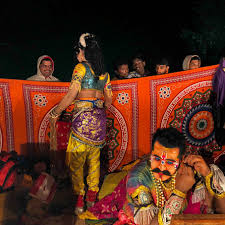
Dashavatar GoaDashavatar is a popular traditional theatre form with a history of eight hundred years. The term Dashavatar refers to the ten incarnations of Lord Vishnu, the Hindu God of preservation. The ten incarnations are ‘matsya’ (fish), ‘kurma’ (tortoise), ‘varaha’ (boar), ‘narasimha’ (lion-man), ‘vaman’ (dwarf), Parashuram, Ram, Krishna, Buddha and Kalki. It is performed during the annual festival of the village deity in the temple premises after midnight, without any technical props.
Each character enters the stage from behind a curtain held by two persons. The Dashavatar performance comprises two sessions, the ‘poorva-ranga’ (the initial session) and the ‘uttar-ranga’ (the latter session). The ‘poorva-ranga’ is the preliminary presentation that precedes the performance proper. The ‘poorva-ranga’ is the story about the killing of the demon Shankhasur.
This act also includes the characters of Lord Ganesha, Riddhi, Siddhi, a Brahmin, Sharada (the goddess of learning), Brahmadev and Lord Vishnu. The ‘uttar-ranga’, known as ‘akhyan’ is considered to be the main performance based on Hindu mythological tales, highlighting one of the ten incarnations of Lord Vishnu. The performance uses bright make-up and costumes. It is accompanied by three musical instruments: a paddle harmonium, tabla and zanj (cymbals).