
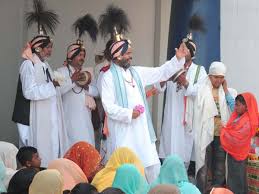
angam Gāyan is a narrative sung by the Jangam community. It is performed in the temple courtyards of Shiva temples to huge gatherings. Sometimes, there are public performances in village squares. The main component of Jangam Gāyan is a poem that deals with the narrative of the wedding of Shiva and Parvati. The poem is sung in a chorus and the singers double up as actors and musicians, as they dramatise the sequence of events leading up to the wedding.
The music accompaniment for the performance is provided by the damru (a small drum, associated with Shiva) and bells. The poem is a rare narrative as it describes a process of transformation of Shiva from a deity to a human being. Significantly, this transformation is an experience of earthly passion leading to the realisation of one’s being. The poem begins with the story of the birth of Parvati. The narrative moves on to a detailed description of Parvati’s growing up into an exceptionally accomplished, beautiful girl and her dream of marrying Shiva, followed by a description of Parvati guiding the Brahmin match maker to the abode of Shiva. This part of the narrative deals with a fascinating expose of Shiva, the wild god in an intoxicated state surrounded by dangerous serpents and black snakes. The poem then elaborates on the preparations and rituals of the marriage ceremony and talks about how Shiva, the wild god becomes a family man who can never afford to displease Parvati.
Alibakshi khayal
Thakur of Mandawara (Alwar) a muslim sub-state of Alwar, gave birth to Alibux, a born saint cum-poet and dramatist, who chose the pursuit of the art as a form of devotion. His association with Hindu saints and Bhaktas imbibed in him the practice of Bhakti through bhajan, kirtan, dancing and singing. His first khyal production was “Krishnaleela”, the first of its kind in khyal technique.
Alibux’s troop performed all around Alwar and was popular even region of Delhi, Agra and Rewari. Alibux style of khyal is different from other khyals in several ways. They have a devotional basis and the songs and lyrical dialogues used are of literary value. They used a great variety of movements while expressing certain emotion, in the accompaniment of Sarangi Dholak and Nakkara. The artist had to live a life of austerity and piousness after the admission in the group.
Panduan ka Kada
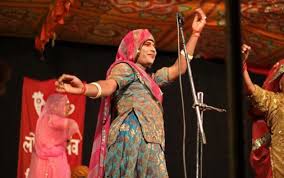
Panduan ka Kada MewatPanduan Ke Kadde is very specific and highly crucial art form for the Meo community of Mewat region, as it carries the cultural identification of the community. The narrative which was written by Saddalah Meo in 16th Century has originally two thousand five hundred couplets and takes approximated forty eight hours of musical rendition. The main instrument ‘Bhapang’ remains the core instrument for the exposition of the narrative but chorus use Harmonium, Dholak, Khanjari also to encompass the performance.The sad part is that now artists don’t use Jogiya Saarangi, which was integral part of the original performances.