
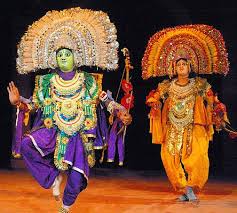
Chhau is a major dance tradition of eastern India. It has three distinct styles Seraikella, Mayurbhanj and Purulia named Masks are an integral part of the dances of Seraikella and Purulia. Chhau dance has a significant role in the celebration of the spring festival Chaitra Parva, being innately connected to its rituals. It is a people’s art as it involves the entire community. Performed by male dancers from families of traditional artists, or those trained under Gurus or Ustads (masters).
It traces its origin to indigenous forms of dance and martial practices. Khel (mock combat techniques), chalis and topkas (stylized gaits of birds and animals) and uflis (movements modeled on the daily chores of a village housewife) constitute the fundamental vocabulary of Chhau dance. The knowledge of dance, music and mask-making is transmitted orally.
It is performed in an open space called akhada or asar and lasts through the night. The dancers perform a repertoire that explores a variety of subjects: local legends, folklore and episodes from the epics Ramayana/ Mahabharata and abstract themes. The vibrant music is characterized by the rhythm of indigenous drums like the dhol, dhumsa and kharka and the melody of the mohuri and shehnai.