
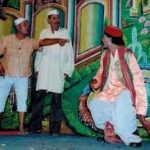
Zadipatti is practised in the rice cultivating region of Maharashtra during the harvest season and derives its name from the local name zadi for rice. The theatre art of this region is known as Zadipatti Rangbhumi. It is a blend of commercial and folk theatre form. Live music is a vital part of the form and the actors are singers as well.
Dashavatar: Traditional folk theatre form
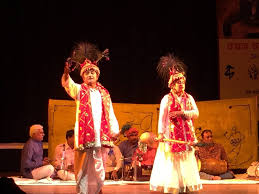
Dashavatar theater Madhya PradeshDashavatar is a popular traditional theatre form with a history of eight hundred years. The term Dashavatar refers to the ten incarnations of Lord Vishnu, the Hindu God of preservation. The ten incarnations are ‘matsya’ (fish), ‘kurma’ (tortoise), ‘varaha’ (boar), ‘narasimha’ (lion-man), ‘vaman’ (dwarf), Parashuram, Ram, Krishna, Buddha and Kalki.
It is performed during the annual festival of the village deity in the temple premises after midnight, without any technical props. Each character enters the stage from behind a curtain held by two persons. The Dashavatar performance comprises two sessions, the ‘poorva-ranga’ (the initial session) and the ‘uttar-ranga’ (the latter session).
The ‘poorva-ranga’ is the preliminary presentation that precedes the performance proper. The ‘poorva-ranga’ is the story about the killing of the demon Shankhasur. This act also includes the characters of Lord Ganesha, Riddhi, Siddhi, a Brahmin, Sharada (the goddess of learning), Brahmadev and Lord Vishnu. The ‘uttar-ranga’, known as ‘akhyan’ is considered to be the main performance based on Hindu mythological tales, highlighting one of the ten incarnations of Lord Vishnu. The performance uses bright make-up and costumes. It is accompanied by three musical instruments: a paddle harmonium, tabla and zanj (cymbals).
Chamadyacha Bahulya -Shadow Puppet Theatre Traditions of India
Chamadyache Bahulya Madhya PradeshThere are six shadow puppet theatre traditions across different regions in India, which are locally known as: Chamadyacha Bahulya in Maharashtra, Tolu Bommalatta in Andhra Pradesh, Togalu Gombeyatta in Karnataka, Tolu Bommalattam in Tamil Nadu, Tolpava Kuthu in Kerala and Ravanchhaya in Orissa.
Though these forms have distinct regional identities, languages and dialects in which they are performed, they share a common worldview, aesthetics and themes. The narratives are mainly based on the epics of Ramayana and Mahabharata, Puranas, local myths and tales. They communicate significant messages to the rural community besides entertainment.
The performance begins with an invocation on a ritually set up stage in a village square or a temple courtyard. Stock characters provide comic relief. A sense of rhythm and dance is inherent in all the traditions, across regions. The puppets are crafted from either goat or deer skin. They are manipulated from behind the screen, where lighting is provided to cast shadows. Puppet performances are a part of festivals, celebrations of special occasions and rituals, and sometimes staged to ward off evil spirits and to invoke the rain gods in times of drought in rural areas.
Chamadyacha Bahulya -Shadow Puppet Theatre Traditions of India
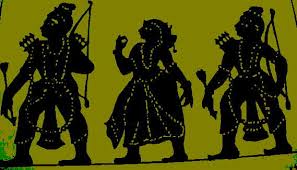
Chamadyache Bahulya Madhya PradeshThere are six shadow puppet theatre traditions across different regions in India, which are locally known as: Chamadyacha Bahulya in Maharashtra, Tolu Bommalatta in Andhra Pradesh, Togalu Gombeyatta in Karnataka, Tolu Bommalattam in Tamil Nadu, Tolpava Kuthu in Kerala and Ravanchhaya in Orissa.
Though these forms have distinct regional identities, languages and dialects in which they are performed, they share a common worldview, aesthetics and themes. The narratives are mainly based on the epics of Ramayana and Mahabharata, Puranas, local myths and tales. They communicate significant messages to the rural community besides entertainment.
The performance begins with an invocation on a ritually set up stage in a village square or a temple courtyard. Stock characters provide comic relief. A sense of rhythm and dance is inherent in all the traditions, across regions. The puppets are crafted from either goat or deer skin. They are manipulated from behind the screen, where lighting is provided to cast shadows. Puppet performances are a part of festivals, celebrations of special occasions and rituals, and sometimes staged to ward off evil spirits and to invoke the rain gods in times of drought in rural areas.