
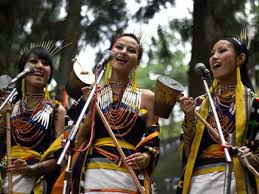
The community cherishes the folk song culture as their proud heritage, which forms as part of every walk of life-work, clebration, dances, folk media, war cry, solo, duet, trio and many such possibilities. In the absence of literary script and the medium being oral, the practitioners sing by memory.
Nazhu festival
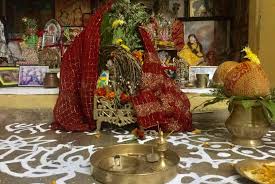
Nazhu festival NagalandThe Nazhu Festival of the Pochury-Naga from Müluori merits attention as it continues to be observed by a small group of people who barely keep alive the ritualistic practices associated with the ancestral religion. In the Azhiewi-Ri (old village) of Müluori, the Laniri Nale Kütsotü (believers of the ancestral faith) of the Pochury-Naga, resists conversion to Christianity and It’s practicing members steadfastly live under the primordial creed.
The festival is defined by various functions and stages of preparation. The most symbolic and unique element common to all is heralding in of Nazhu, with the erection of a bamboo totem Awuthrüu, that resembles a giant wind chime hung from a tall bamboo. In Christian homes the totem is erected any day from the 20th to 24th February. For the Laniri Nale, the totem goes up on the 24thFebruary with all the formalities completed on this day.
Chhau Dance
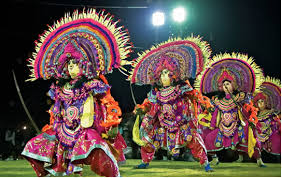
Chhau Dance OdishaChhau is a major dance tradition of eastern India. It has three distinct styles Seraikella, Mayurbhanj and Purulia named Masks are an integral part of the dances of Seraikella and Purulia. Chhau dance has a significant role in the celebration of the spring festival Chaitra Parva, being innately connected to its rituals.
It is a people’s art as it involves the entire community. Performed by male dancers from families of traditional artists, or those trained under Gurus or Ustads (masters). It traces its origin to indigenous forms of dance and martial practices. Khel (mock combat techniques), chalis and topkas (stylized gaits of birds and animals) and uflis (movements modeled on the daily chores of a village housewife) constitute the fundamental vocabulary of Chhau dance.
The knowledge of dance, music and mask-making is transmitted orally. It is performed in an open space called akhada or asar and lasts through the night. The dancers perform a repertoire that explores a variety of subjects: local legends, folklore and episodes from the epics Ramayana/ Mahabharata and abstract themes. The vibrant music is characterized by the rhythm of indigenous drums like the dhol, dhumsa and kharka and the melody of the mohuri and shehnai.
Ravanachhaya – Shadow Puppet Theatre Traditions of India
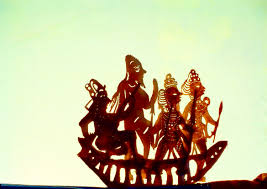
Ravanachhaya OdishaThere are six shadow puppet theatre traditions across different regions in India, which are locally known as: Chamadyacha Bahulya in Maharashtra, Tolu Bommalatta in Andhra Pradesh, Togalu Gombeyatta in Karnataka, Tolu Bommalattam in Tamil Nadu, Tolpava Kuthu in Kerala and Ravanchhaya in Orissa.
Though these forms have distinct regional identities, languages and dialects in which they are performed, they share a common worldview, aesthetics and themes. The narratives are mainly based on the epics of Ramayana and Mahabharata, Puranas, local myths and tales. They communicate significant messages to the rural community besides entertainment. The performance begins with an invocation on a ritually set up stage in a village square or a temple courtyard. Stock characters provide comic relief.
A sense of rhythm and dance is inherent in all the traditions, across regions. The puppets are crafted from either goat or deer skin. They are manipulated from behind the screen, where lighting is provided to cast shadows. Puppet performances are a part of festivals, celebrations of special occasions and rituals, and sometimes staged to ward off evil spirits and to invoke the rain gods in times of drought in rural areas.