
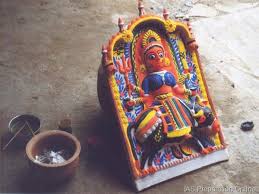
Votive terracotta painted plaques produced by the terracotta artisans of Molela is a hand modelled hollow relief of Hindu deities, especially of the neo-Vaishnava deity, Dev Narayan. Dev Narayan is accompanied by his characteristic snake symbol in the plaque. Made from clay, mixed with rice husk and donkey dung in required proportion, the plaque is sun dried and baked in an indigenous kiln before it is painted with mineral colours and eventually coated with a local made lacquer, called ‘jala’.
Several tribes in Gujarat and Rajasthan travel for more than 200 km once in a year to buy these plaques from Molela and bring them to their villages. Each group is led by a ‘bhopa’, the family priest, who helps to identify the appropriate deity for the family. These deities are installed and worshipped for 3 to 5 years in the shrines located in their villages till they are replaced by the new ones.
Each shrine inhabits a minimum of nine such plaques of several gods and goddesses including Dev Narayan. Terracotta artisans from Molela are the only community entitled to meet this requirement of the tribes. This system has provided sustenance to the traditional craftsmanship for several generations.
Kalbelia: Folk Songs and Dances
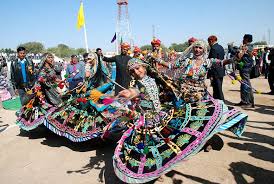
Kalbelia RajasthanKalbelia Dance is an expression of the Kalbelia community’s way of life as snake charmers. The women in flowing skirts dance to the beat of the ‘khanjari,’ a percussion instrument, and the ‘poongi,’ a wind instrument. Both these instruments are made by the Kalbelias themselves from natural materials like dried vegetable gourds and leather hide. On the occasion of Holi (the festival of colours), the Kalbelias perform a special dance with another percussion instrument called the ‘chang.’
While men play the instruments, the women sing and dance. It is remarkable that in today‘s context, the Kalbelia‘s traditional music and dance has evolved into a creative and contemporary version that enthralls audiences worldwide. The music of the ‘poongi’ has a sinuous quality, which makes a dancer swirl and dance like a serpent. The songs also portray the creative and poetic acumen of the Kalbelias. The Kalbelias are reputed to compose lyrics spontaneously and improvise songs impromptu during a performance. The vast repertoire of songs covers all the rites of passage in their life.
Practice of turban tying in Rajasthan

Practice of turban tying in RajasthanThe practice of turban tying, (safa wearing in local parlance), consists of tying a long, generally unstitched cloth, in a set manner of wrapping in folds, which is tied on the head of men. The cloth could have a plain texture or be printed in various designs. There are two primary variants: a) safa, which is 8 – 10 m in length, and 1 m in width; and b) paag or pagdi, which is around 20 m in length, and 20 cm in width.
Given the immensity of length, the tying of a turban is a complex mechanism. Each community has its own unique style of wearing this outfit. The earliest evidence of the element is available from a 2nd century BC statue of the Kushana period, depicting a woman wearing a turban. However, the modern turban is around 300 years old, and is worn now by men only. British ethnographers of the colonial period have recorded the phenomenon vividly. Today, the turban is a symbol of pride and identity.
Also, it has several practical uses. It protects the wearers’ head from extreme temperatures. The turban can be used as a pillow, a mattress, or a rope to draw water from wells. Rajasthan is a desert state, and people have compensated for the lack of colour in nature through colourful attires and music, and the myriad hues of turbans are in consonance with that. Whether the context is rural or urban, the turban is ubiquitous and the most visible living tradition of the state.
Phad: Scroll Paintings and Their Narration
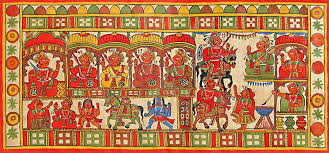
Phad is an approximately 30 feet long and 5 feet broad painted scroll, which depicts stories of epic dimensions about local deities and legendary heroes. The local priests – the Bhopas, render these stories musically. Phad when not in use is kept folded in the village shrine or in Bhopa‘s house. Bhopas carry these scrolls on their shoulders from village to village for a performance, where they unfold the scroll and display it fixed on to a bamboo frame in an open area. Phad represents the moving shrine of the deity and is an object of worship. Some of the most popular and largest Phad belong to local deities Devnarayanji and Pabuji. The performance takes place at night and Bhopi (priest‘s wife), lights up a lamp to make the images visible. Stories of Devnarayanji are rendered with the accompaniment of the musical instrument called Jantar‘; and a two-string instrument called Bana accompanies the epic of Pabuji.