

The Alu Kurumbas of Tribal Nilgiris , apart from decorating the walls of their dwelling huts with their indigenous peintings, are observed to draw caricature sketches of human beings over the rock outcrops in and around their indigenous habitats in order to bring magical effects on the people depicted therein.
The graphic art tradition of Alu Kurumbas of Tribal Nilagiris might be traced back to the Prehistoric Period from the cultural point of view wherein the rock art site of Vellaricombai is regarded as their sacred site. Moreover, the Alu Kurumbas are observed to venerate the ‘ key anthropomorphic figure’ of that site as their ‘ancestral spirit’ and believe that it could be revitalized by periodical (annual) re-touching and or re-drawing the ritual cult figure (drawn already & masked with lime coat) on the wall of their shaman’s hut. They use the leaf juice (Pachchele Chaaru) and the latex extract (Vaenga Paalu) as the paint and the aerial root of banyan tree (Aalanguchchi Vaeru) as the painting brush.
Pinal Kolattam
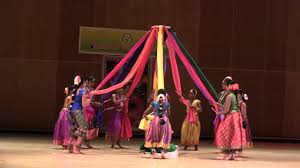
Kolattam is an ancient folk dance performed by women in a group during the harvesting season. The Tamil traditional dance Pinnal Kolattam is similar in genre to the Kolattam and is also performed by women in a group during the harvesting season. The prop used in Pinnal Kolattam is a rope instead of sticks as in Kolattam. The women form a large circle and hold one end of the colorful rope while the other is tied to a tall pole. The women dance around the pole weaving in and out of the circle forming intricate and beautiful patterns with the ropes they are holding. When the lace like pattern is complete and there is not enough rope to dance with, the women reverse the steps and unwind the ropes.
Nattu Adi Murai
‘Nattu Adi Murai’ (Country fighting method) or ‘Nattu Vilaiyattu’ (country martial games) is one among the traditional martial art forms of Tamil Nadu.
Kolam: Ritualistic Threshold Drawings and Designs of Tamil Nadu
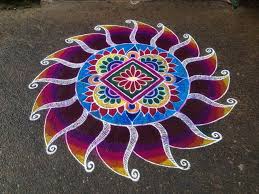
Kolam Tamil NaduKolam is a ritualistic design drawn at the threshold of households and temples. It is drawn everyday at dawn and dusk by women in South India who inherit this tradition from their elders. Kolam is believed to be a labyrinth to ensnare harmful spirits and prevent them from causing harm. Kolam marks festivals, seasons and important events in a woman’s life such as birth, first menstruation and marriage.
Kolam indicates a sphere of ‘positive vibes‘ generated by a feminine energy that influences both the interior domestic space and the outside world. Kolam is a free-hand drawing with symmetrical and neat geometrical patterns. The drawings are very conceptual and a huge repertoire of designs is stored in the cultural memory of the people.
Kolam is laid on a mathematical dotted grid. It is produced either by nonlinear lines interlaced in endless knots around dots, or by lines connecting dots in a decorative design. Kolam, with its mathematical abstraction, geometric shapes and repetitive units, accommodates floral motifs, birds, animals, butterflies, intertwined snakes etc. The deceptively simple domestic art of Kolam is as intricate and conceptual as the jacquard weave or the Islamic tile design. Comparisons are also drawn with Roman floor mosaics and Celtic interlaces.
Tolu Bommalattam – Shadow Puppet Theatre Traditions of India
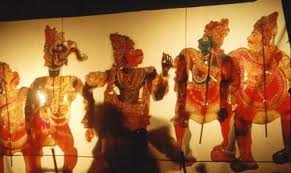
There are six shadow puppet theatre traditions across different regions in India, which are locally known as: Chamadyacha Bahulya in Maharashtra, Tolu Bommalatta in Andhra Pradesh, Togalu Gombeyatta in Karnataka, Tolu Bommalattam in Tamil Nadu, Tolpava Kuthu in Kerala and Ravanchhaya in Orissa. Though these forms have distinct regional identities, languages and dialects in which they are performed, they share a common worldview, aesthetics and themes.
The narratives are mainly based on the epics of Ramayana and Mahabharata, Puranas, local myths and tales. They communicate significant messages to the rural community besides entertainment. The performance begins with an invocation on a ritually set up stage in a village square or a temple courtyard. Stock characters provide comic relief.
A sense of rhythm and dance is inherent in all the traditions, across regions. The puppets are crafted from either goat or deer skin. They are manipulated from behind the screen, where lighting is provided to cast shadows. Puppet performances are a part of festivals, celebrations of special occasions and rituals, and sometimes staged to ward off evil spirits and to invoke the rain gods in times of drought in rural areas.