
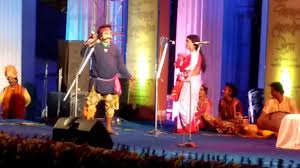
Manosa Gaan are songs sung in praise of Goddess Manosa in West Bengal. They are a part of the various ‘Mangal Kavyas’ (songs of benevolence) which are based on the life of gods and goddesses and other mythological tales. The most popular Mangal Kavyas of Bengal are Chandi Mangal, Manosa Mangal and Dharma Mangal. Manosa Gaan has been sung in several villages of West Bengal since ages. Along with singing songs, worship of Goddess Manosa and community cooking also takes place. Goddess Manosa is associated with snakes and it is believed that her worship protects one from snake bites.
Deowal Chitra and Alpana
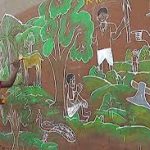
Deowal Chitra (Drawing on wall) and Alapana (Drawing on floor) are part of visual folk art of Santhals and reflect simplicity, honesty and a quiet vigour. Traditional motifs, such as the lotus, the sun, the tree-of-life, flowery creepers, fish, elephants etc. are seen in these paintings.The deowal chitra is executed with natural pigments on two main portions of the hut- the Pinda or the Plinth and the Kanth or wall above the plinth. Alpana is executed with a finger by dipping it in rice powder paste and by drawing fluid, rhythmic lines, mostly for ritualistic purposes.
Kushan Gaan
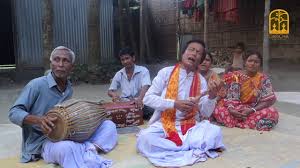
The kusan involves, singing, recitation of dialogue, acting, dancing, and musical accompaniment. The themes are essentially religious in nature and revolve around portions of Ram’s sons Kush and Lob in the Ramayan. It’s an Oral Tradition probably influenced by Bangla Kritibasi Ramayan and used the local language in the time dialogue and song.
Durga Puja in West Bengal
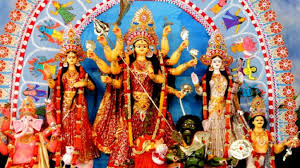
Durga Puja is the most important socio-cultural and religious event in the Bengali festival calendar, celebrated in autumn. The
festival is to propitiate the Goddess Durga for her blessings as also celebrate her victory over the demon Mahishasur. It is also believed that Lord Rama had worshipped the goddess Durga to seek divine blessings before undertaking the battle against Ravana.
Durga Puja is a ten-day festival, usually in October, which starts from Mahalaya, the inaugural day of the event. Mahalaya is celebrated by Agomoni or songs of welcome. Festivities start five days later with the observance of Shashti, Shaptami, Ashtami, and Nabami. An elaborate community bhog or food-offerings to the Goddess, is prepared and then partaken by congregations on each day of the festivities. On the tenth day, or Bijoya Dashami, the goddess is borne away to the sounds of the dhak, or traditional drum for immersion in nearby rivers or water bodies. The puja mandap or the main altar is essentially a platform inside a makeshift bamboo structure called a pandal. The rituals are performed by designated priests in front of the deities inside the mandap. Offerings of fruits, flowers, sweetmeats, incense and sandalwood are placed in platters in front of the deities while the congeragation in the pandal repeat the mantras, or holy chants, after the priest, conducting the services. The makeshift structures, as well as the image of the goddess are adorned with meticulous artwork and stylistic themes made with local craft materials such as shola or pith, coloured jute, woven brocades, imitation jewellery, clay and terracotta ornamentation.
Gaudiya Nritya
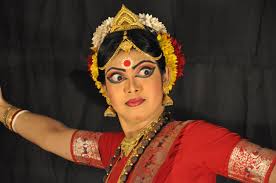
Gaudiya Nritya is a classical dance form of Bengal as well as of other Eastern parts of the country like Assam, Odisha and Manipur. It has its origins in the Natyashastra. Its technique and repertoire were developed by the erstwhile nobility who were both performers and teachers. Shree Chaitanya Mahaprabhu had made a significant contribution to popularize this ancient dance form in Bengal, Manipur and parts of Orissa.
It was widely used in the Vaishnav societies. However, due to lack of patronage the practice of this dance form has almost disappeared. The performance of Gaudiya Nritya is based on mythological stories. Transmission of its knowledge follows Guru-Shishya parampara.
Bonobibir Pala
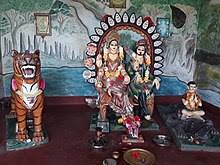
In southern Bengal, men of the villages set out for jungle before the arrival of monsoon. If they manage to return from jungle, it is believed that it has happened by the grace and generosity of ‘Maa Bonobibi’. Hence, in ‘Maghi Poornima’ or the full moon night of the Bengali calendar month Magh (January-February) the entire village workships Goddess Bonobibi.
The villagers cook and eat together in front of her makeshift temple (Thaan), recall the benevolence of Goddess Bonobibi and perform the original unedited play or ‘Pala’ named ‘Bonobibir Johuranama’ for the entire night. That is the traditional way to present Bonobibir Pala. Nowadays, however, many troupes have formed who perform the Pala to entertain the tourists. Naturally, they have to edit and redesign the original overnight long folk play to a redefined presentation of maximum one hour.