
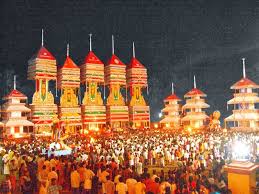
Chettikulangara Kumbha Bharani Kettukazhcha, a post-harvest float festival, is a spectacular confluence of art, culture, architecture and the dedicated human endeavour of approximately 50000 people. The festival is held as thanksgiving to the Goddess Bhadrakali, for the rich harvest gathered in, and protection from diseases and calamities. It begins on the day of Shivarathri and concludes on the ‘Bharani’ day of the Kumbha month of the Malayalam calendar (during February or early March).
Over half-a-million people participate with passion and devotion in the two-week long festivities. In the evenings, devotees conduct a unique dance-song ritual named Kuthiyottam where the entire village is in attendance. Sumptuous community feasts are served thrice a day as part of the celebrations. The grand finale of the festivities is the dragging of decorative floats to the local shrine of the Goddess.
The floats weigh hundreds of tonnes and stand 20-30 metres tall, with a square base of 16 (4X4m) to 25 sq. meters (5X5m) approx, tapering to the top in a pyramidal form. The framework of these floats harks back to Buddhist tradition and to Kerala’s traditional temple architecture. The wooden structures are made using wood, coconut and arecanut tree poles, coir, and are covered with colourful embellishments and ornamental ‘torans’ or fringes. Two huge wooden sculptures of the epic figures of Bhima and Hanuman are included in the group of floats.
The event is possibly among the largest mobile float festivals in the world, in terms of size of the floats and participation of communities concerned.
Kalaripayuttu
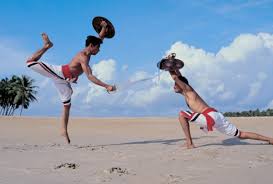
Kalarippayattu is the martial art originated and popularly practiced in Kerala. Mythology has it that the warrior sage Parasurama is the promulgator of Kalarippayattu. Kalari is the Malayalam word for a traditionally built gymnasium to teach the martial art known as Payattu. The four stages of Payattu are: a) Maippayattu – Body conditioning exercises b) Kolthari – Use of wooden weapons c) Angathari – Use of sharp metalic weapons d) Verumkai – Bare-handed defense and attack
Tolpava Kuthu – Shadow Pupper Theatre Traditions of India
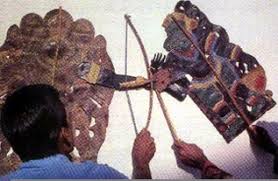
Tolpava Kuthu KarnatakaThere are six shadow puppet theatre traditions across different regions in India, which are locally known as: Chamadyacha Bahulya in Maharashtra, Tolu Bommalatta in Andhra Pradesh, Togalu Gombeyatta in Karnataka, Tolu Bommalattam in Tamil Nadu, Tolpava Kuthu in Kerala and Ravanchhaya in Orissa. Though these forms have distinct regional identities, languages and dialects in which they are performed, they share a common worldview, aesthetics and themes.
The narratives are mainly based on the epics of Ramayana and Mahabharata, Puranas, local myths and tales. They communicate significant messages to the rural community besides entertainment. The performance begins with an invocation on a ritually set up stage in a village square or a temple courtyard. Stock characters provide comic relief.
A sense of rhythm and dance is inherent in all the traditions, across regions. The puppets are crafted from either goat or deer skin. They are manipulated from behind the screen, where lighting is provided to cast shadows. Puppet performances are a part of festivals, celebrations of special occasions and rituals, and sometimes staged to ward off evil spirits and to invoke the rain gods in times of drought in rural areas.
Mudiyettu: Ritual Theatre and Dance Drama
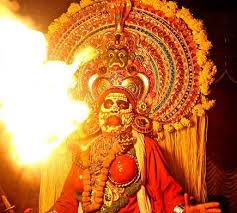
Mudiyettu KarnatakaMudiyettu is a ritual theatre form of Kerala based on the mythological tale of the battle between Goddess Kali and Darika, an evil king. It is a community ritual in which the entire village participates. After the summer crops have been harvested, the villagers reach the temple early in the morning on an appointed day. The traditional performers of Mudiyettu having purified themselves by observing the ritual of fasting and offering prayers to the goddess proceed to draw a huge tantric design of Goddess Kali made of powdered rice, on the temple floor.
Over a period of time the tradition of chanting the praises of Kali has evolved into a vibrant musical form that accompanies the ‘panchavarna kalam’ (A five colour design on the floor depicting the Goddess). It is drawn on the floor to help the performers imbibe the spirit of the goddess. The performance takes a dramatic turn when Darika, from the top of the eastern mountains, challenges Kali to a battle. Kali, born of Lord Shiva‘s (A Hindu god) third eye, retaliates. Kooli, the clown and Koimpada Nair, the chieftain of the ‘pancha boothas’ (five elements), become her allies in this battle against evil.
The temple courtyard turns into a battle field and the villagers the participants in this ritual-theatre event. In the end, after a fierce battle, Kali defeats her adversaries and performs the victory dance. The devotees hail their goddess and welcome the dawn of a peaceful and prosperous new year.
Kutiyattam, Sanskrit theatre
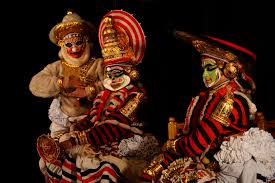
Kutiyattam KarnatakaKutiyattam, Sanskrit theatre, which is practised in the province of Kerala, is one of India’s oldest living theatrical traditions. Originating more than 2,000 years ago, Kutiyattam represents a synthesis of Sanskrit classicism and reflects the local traditions of Kerala. In its stylized and codified theatrical language, neta abhinaya (eye expression) and hasta abhinaya (the language of gestures) are prominent.
They focus on the thoughts and feelings of the main character. Actors undergo ten to fifteen years of rigorous training to become fully-fledged performers with sophisticated breathing control and subtle muscle shifts of the face and body. The actor’s art lies in elaborating a situation or episode in all its detail. Therefore, a single act may take days to perform and a complete performance may last up to 40 days. Kutiyattam is traditionally performed in theatres called Kuttampalams, which are located in Hindu temples.
Access to performances was originally restricted owing to their sacred nature, but the plays have progressively opened up to larger audiences. Yet the actor’s role retains a sacred dimension, as attested by purification rituals and the placing of an oil lamp on stage during the performance symbolizing a divine presence. The male actors hand down to their trainees detailed performance manuals, which, until recent times, remained the exclusive and secret property of selected families. With the collapse of patronage along with the feudal order in the nineteenth century, the families who held the secrets to the acting techniques experienced serious difficulties. After a revival in the early twentieth century, Kutiyattam is once again facing a lack of funding, leading to a severe crisis in the profession. In the face of this situation, the different bodies responsible for handing down the tradition have come together to join efforts in order to ensure the continuity of this Sanskrit theatre.