
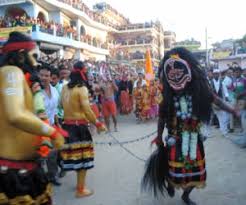
The meaning of the word Hill Jatra is – Jatra or group dance that is perfomed in the mud. Hill jatra is perfomed in the Kumor village of Pithoragarh region of Uttarakhand eight days after the festival of ‘ Gor-Maheshwar’ , during the month of Bhadra. The Hilljatra is related to ropai ( the plantation of paddy ) and other agricultural and pastoral labours of the rainy season.
Different pastoral and agricultral activities are presented in a dramatic way like a pair of buffaloes, ploughman etc, and also the regional gods and goddesses. The main attraction of the Hill Jatra is the Hiran Chittal, Lakhiyabhoot and Mahakali. The Lakhiyabhoot is specifically performed in Kumor, and was established in Kumor after being brought from Nepal. Other villages of Pithoragarh which celebrates Hill Jatra are Satgaarh, Bajeti, Didihaat and Kanalichhena, clebrate it only with the Hiran Chittal (Deer Mask Dance) and Mahakali dance. Musical instruments like Nagada, Dhamau and Bhonkar are used during the various performances to give dramatic effects.
Ramman: Religious Festival and Ritual Theatre of the Garhwal Himalayas
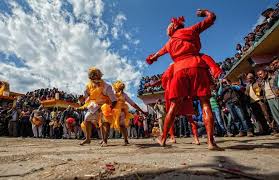
Ramman is a form of traditional ritual theatre celebrated every year in the courtyard of the temple of Bhumiyal Devta situated in Saloor Dungra Village in Painkhanda valley of Chamoli district, Uttarakhand, India. The village deity of Saloor Dungra is Bhumichetrapal where he is better known as Bhumiyal Devta. It is in this temple where every year Ramman festival is organized by the local inhabitants.
Though no historical account of this tradition is available before 1911, the tradition itself existed much before that. The documents available with the community tell that the history of this particular fair is more than hundred years old. The date for the festival and performance is traditionally fixed by the village priest which usually falls on the 13th of April every year.
On the auspicious day of sankranti (Baisakhi) in the month of Baisakh, Bhumiyal Devta comes out in a procession from his place of residence (which is one house in the village) to the central temple of the village accompanied by beating of drums and mask dances. After the festivity come to a close for the year, Bhumiyal Devta goes to live in one of the houses for the entire year till the next Baisakhi festival. His place of residence in the village is decided by the Village Panchayat.
Kumbh Mela
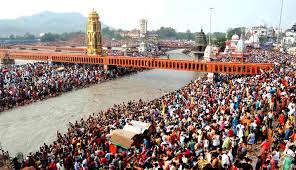
Kumbh Mela or Kumbha Mela is a mass congregation of generally Hindu pilgrims in which people gather to take a bath/dip in a sacred river. It is considered to be the largest peaceful gathering in the world. A ritual bath at a predetermined time and place is the major event of the festival, called the Shahi Snan . It is celebrated four times every 12 years, the site of the observation rotating between four pilgrimage places on the four sacred rivers at Allahabad, Haridwar, Ujjain and Nashik.
Ardha (“Half”)Kumbh Mela is held at only two places, Haridwar and at Allahabad, every sixth year. And a Maha Kumbh is held after every 144 years. A great fair is held on these occasions on the banks of these rivers with a huge congregation of devoted pilgrims. The festival of Kumbh or Ardh Kumbh is not a festival of market or fair instead it is the festival of knowledge, asceticism and devotion. People from every religion and caste are present in the festival in one form or the other, and it takes the shape of a Mini India.
Different types of language, tradition-culture, dresses, food, way of living, can be seen at the festival and the most important specialty is that millions of people reach the place without any invitation. Kumbha is a Sanskrit word for Pitcher, referred to as Kalasha, it is also a zodiac sign in Indian astrology, the sign under which the festival is celebrated. Kumbh is also the human body; the sun, earth , sea and Vishnu (Hindu God) are its synonyms. The elemental meaning of Kumbh says that it’s a confluence of all cultures, and is a symbol of spiritual awakening.
While Mela means a ‘gathering’ or ‘a meet’ or simply a fair. To understand the significance of the Kumbha Mela and the important role that it plays in the spirituality of India, it is imperative to know the background of the sacred Ganges River. The devout believe that simply by bathing in the Ganges one is freed from their past sins (karma), and thus one becomes eligible for liberation from the cycle of birth and death.
Of course it is said that a pure lifestyle is also required after taking bath, otherwise one will again be burdened by karmic reactions .The pilgrims come from all walks of life, travelling long distances and tolerating many physical discomforts, such as sleeping in the open air in near freezing weather. They undergo such difficulties just to receive the benefit of taking a bath in the sacred river at Kumbha Mela and to meet the great saints.
Aipan Art
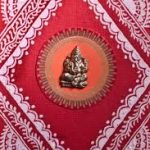
Aipan – the traditional folk art form for exterior and interior decoration in Kumaoni household of Uttarakhand have characteristic symbol representations related to religious Pooja ceremonies or Sanskar ceremonies connected with birth, birthdays, Upnayan (Yagyopaveet), wedding etc. The execution of these designs is often synchronized with songs of the women, the chanting of mantras by the priest, the playing by musicians of musical instruments such as kettledrums and pipes, and the ringing of bells and blowing of conch shells.
The folk art of Kumaon can broadly be classified into these groups: 1) Aipan-floor decorations 2) Bar-Boond or wall patterns 3) Jyonti and patta or figure patterns 4) Dikara or clay image. These wall and floor configurations consist primarily of geometrical patterns, and the main symbols employed are the line, dash, dot, circle, square, triangle, swastika and lotus, all of which seem to have had their origin in the Puranas and Tantric rituals.