
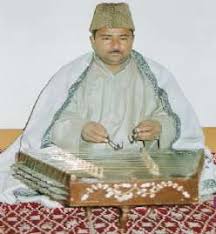
Like Indian classical music, the concept of Gharana also exists in Sufiana Mausiqi. In the past there were a number of Gharanas of Sufiana Mausiqi. These gharanas were spread across the length and breadth of Kashmir valley. But nowadays there are only three districts in Kashmir where Sufiana music is practiced. These include district Budgam, district Anantnag and district Srinagar. One of the most prominent gharanas of District Budgam is Qaleenbaft Gharana. The gharana is named after the most renowned musician of the gharana, Ustad Ghulam Mohammad Qaleenbaft.
It is an offshoot Gharana of Ramzan Joo Gharana. Ustad Qaleenbaft later developed his own style and founded a separate Gharana. For example it was the custom of Ramzan Joo Gharana to maintain a single tempo (laya) through out the presentation of a Maqam but Ustad Qaleenbaft would change the tempo of the Maqam from Vilambit (slow) to Madhya (medium) and Drut (fast) tempo, while presenting the Jawab of the Maqam. (Jawab is instrumentally repeated after a Waqf or rest during the presentation of a Maqam).
Ustad Qaleenbaft was able to establish himself as of the leading Sufiana musicians.He produced many good musicians like late Sheikh Abdul Aziz, Mushtaq Ahmad, Shakeel Ahmad Lala and the present Khalifa of the Gharana, Ustad Mohammad Yaqoob Sheikh (grandson of Ghulam Mohammad qaleenbaft). One of the prominent gharanas of District Budgam Kashmir is Kamal Bhat gharana.
This gharana is the gharana of Bhands and is named after top most musician of the gharana, Ustad Kamal Bhat. Ustad Kamal Bhat and his Family were professional musicians. He was very proficient in playing the following Talas- Nimdor, Mukhammas, Saqeel, Nim Saqeel, Hijaz, Dor-e-Khafif, Duroya, Yeka, Doyeka, Sehtal, Chapandaz, and Ravani and so on.
Haran
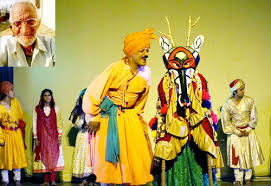
Haran is a traditional folk theatre form performed during Lohri festival. Playing “Haran” is an ancient traditional culture of our Duggar pardesh.”Haran” is derived from the Hindi ward “Hiran” i.e. Deer. The Group that plays Haran comprises of 10-15 members who perform different characters and amuse the spectators while delivering very important messages on social and political evils.
Two artists act as “Hiran” who are well decorated like a beautiful Deer with ”Ghungrus” tied to their feet. Two anchors perform as Lamberdar and Chowkidar, whereas others support them in the character of old woman, Narad, Sadhu, Patwari, Gujjar, Gujjari, Maskhara etc. The characters may change depending upon the situations.