
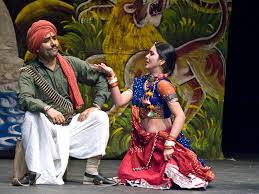
Nautanki, a folk operatic theatre form, has emerged out of many traditions such as Bhagat, Swaang etc. It implies acting with and through singing. Central to the performance is the Nakkara, a percussion instrument which heralds the announcement of the start of a performance, bringing the audience into the performing space, which could vary from the village square to the marketplace.
The audience sits around a raised platform (sometimes constructed) on which a nightlong performance takes place. The atmosphere is informal and interactive. The stories vary from episodes in the Ramayana and Mahabharat (like Satya Harishchandra) to Persian tales like Laila Majnu. Many groups use written scripts by authors, like Natharam Gaur, but there is ample scope for improvisation and spontaneity.
Heightened poetry consisting of metric patterns of different syllables like doha, tabil, maand, khamsa, dedtuki, behre tabil, chaubola, are used. There is an element of high drama because of emotional conflicts and universal situations that are played out, incorporating shades of valour, pathos and love. In Hathrasi style there is an emphasis on singing which borders on classical ragas, but the artist has the freedom to add individual colour and improvise spontaneously while performing.
The Kanpur style incorporates stylised and eloquent speech with broad clear gestures. Interludes, comedy and dances are interwoven, which over a period have gained popularity. Earlier the female roles were enacted by male actors but the 1930s entry of women changed the scenario completely. Some groups use elaborate costumes while others do not consider this essential.
Ramlila, the traditional performance of the Ramayana
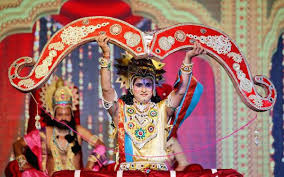
Ramlila, literally “Rama’s play”, is a performance of then Ramayana epic in a series of scenes that include song, narration, recital and dialogue. It is performed across northern India during the festival of Dussehra, held each year according to the ritual calendar in autumn. This staging of the Ramayana is based on the Ramacharitmanas, one of the most popular storytelling forms in the north of the country.
This sacred text devoted to the glory of Rama, the hero of the Ramayana, was composed by Tulsidas in the sixteenth century in a form of Hindi in order to make the Sanskrit epic available to all. The majority of the Ramlilas recount episodes from the Ramacharitmanas through a series of performances lasting ten to twelve days, but some, such as Ramnagar’s, may last an entire month. Festivals are organized in hundreds of settlements, towns and villages during the Dussehra festival season celebrating Rama’s return from exile.
Ramlila recalls the battle between Rama and Ravana and consists of a series of dialogues between gods, sages and the faithful. Ramlila’s dramatic force stems from the succession of icons representing the climax of each scene. The audience is invited to sing and take part in the narration. The Ramlila brings the whole population together, without distinction of caste, religion or age. All the villagers participate spontaneously, playing roles or taking part in a variety of related activities, such as mask- and costume making, and preparing make-up, effigies and lights. However, the development of mass media, particularly television soap operas, is leading to a reduction in the audience of the Ramlila plays, which are therefore losing their principal role of bringing people and communities together.
Kumbh Mela
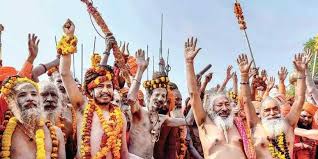
Kumbh Mela or Kumbha Mela is a mass congregation of generally Hindu pilgrims in which people gather to take a bath/dip in a sacred river. It is considered to be the largest peaceful gathering in the world. A ritual bath at a predetermined time and place is the major event of the festival, called the Shahi Snan.
It is celebrated four times every 12 years, the site of the observation rotating between four pilgrimage places on the four sacred rivers at Allahabad, Haridwar, Ujjain and Nashik. Ardha (“Half”)Kumbh Mela is held at only two places, Haridwar and at Allahabad, every sixth year. And a Maha Kumbh is held after every 144 years. A great fair is held on these occasions on the banks of these rivers with a huge congregation of devoted pilgrims.
The festival of Kumbh or Ardh Kumbh is not a festival of market or fair instead it is the festival of knowledge, asceticism and devotion. People from every religion and caste are present in the festival in one form or the other, and it takes the shape of a Mini India. Different types of language, tradition-culture, dresses, food, way of living, can be seen at the festival and the most important specialty is that millions of people reach the place without any invitation.
Kumbha is a Sanskrit word for Pitcher, referred to as Kalasha, it is also a zodiac sign in Indian astrology, the sign under which the festival is celebrated. Kumbh is also the human body; the sun, earth , sea and Vishnu (Hindu God) are its synonyms. The elemental meaning of Kumbh says that it’s a confluence of all cultures, and is a symbol of spiritual awakening.
While Mela means a ‘gathering’ or ‘a meet’ or simply a fair. To understand the significance of the Kumbha Mela and the important role that it plays in the spirituality of India, it is imperative to know the background of the sacred Ganges River. The devout believe that simply by bathing in the Ganges one is freed from their past sins (karma), and thus one becomes eligible for liberation from the cycle of birth and death.
Of course it is said that a pure lifestyle is also required after taking bath, otherwise one will again be burdened by karmic reactions .The pilgrims come from all walks of life, travelling long distances and tolerating many physical discomforts, such as sleeping in the open air in near freezing weather. They undergo such difficulties just to receive the benefit of taking a bath in the sacred river at Kumbha Mela and to meet the great saints.