
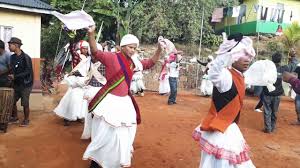
Rongkhli or ‘Tiger Festival’ is a religious festival celebrated by the people of Nongtalang village in the War-Jaintia region of Meghalaya. Rong means festival and Khli means tiger, in the local dialect, hence Rongkhli means Tiger Festival.
Tradition has it that whenever any person from the village catches a tiger or its feline like, rituals have to be performed.The people of Nongtalang worship two goddesses namely; Ka Pyrtuh and Ka Kapong. The Dorbar is then summoned by the Chief of the village and a date is decided for the Festival. The festival is mainly held in the month of January to March, mainly in the dry months.
Traditional Drums of Garo Community
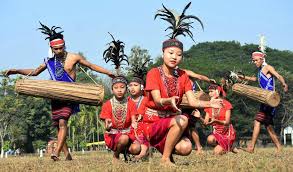
Traditional Drums of Garo Community MeghalayaGaros are a tribal group from Meghalaya, predominantly residing in the Garo Hills region. Though found in the three (now five) Garo Hills districts, they also reside in the adjoining states of Assam, Tripura, Nagaland, and West Bengal in the Indian Union and across the political divide in the northern districts of Bangladesh.
Traditionally the Garos are agriculturists, and therefore much of their livelihood and religion revolved around it. Thus, various music (songs/incantations/ballads/prayers etc) forms a part and parcel of their livelihood. Additionally, various musical instruments are used not only as accompaniment to these songs and incantations, but also as symbols to various social occasion. The Garos have a wide range of drums ranging from 4 feet 3 inches in length to the tiniest which is about 5inch in length.
They prefer the gambil (b. Careya arborica) wood for the frames of the drums. The wood is hollowed through with a sharp tool called batra which is made by the local blacksmith. However the construction of the drum is purely done by the Garos themselves. The drums are usually hung from the neck and played by both hands while dancing,and at times, they are placed on the ground and played while sitting.
There are different types of drums, the three major categories being the following: (a) Dama: This is the ceremonial drum used in different ceremonies and festive occasions. (b) Dama dalsang/ Kodoreng/ Nagra: It is a large drum consisting of an earthen pot covered with skin. This will be detailed in the final report. (c) Kram: This is the sacred drum. It has two other similar ones attached to it known as kram nadik and bitchimani bisa. Except for the nagra, kram, nadik and bitchimani bisa, all the other drums are kept in the bachelor’s dormitory (nokpante).
The Garos have different styles of playing the drum depending on the area they come from. They also have different players such as a single lead drummer called dadigipa, one accompanist or second drummer known as rikkakgipa and any number of bass drummers known as onlgrimgipa.